
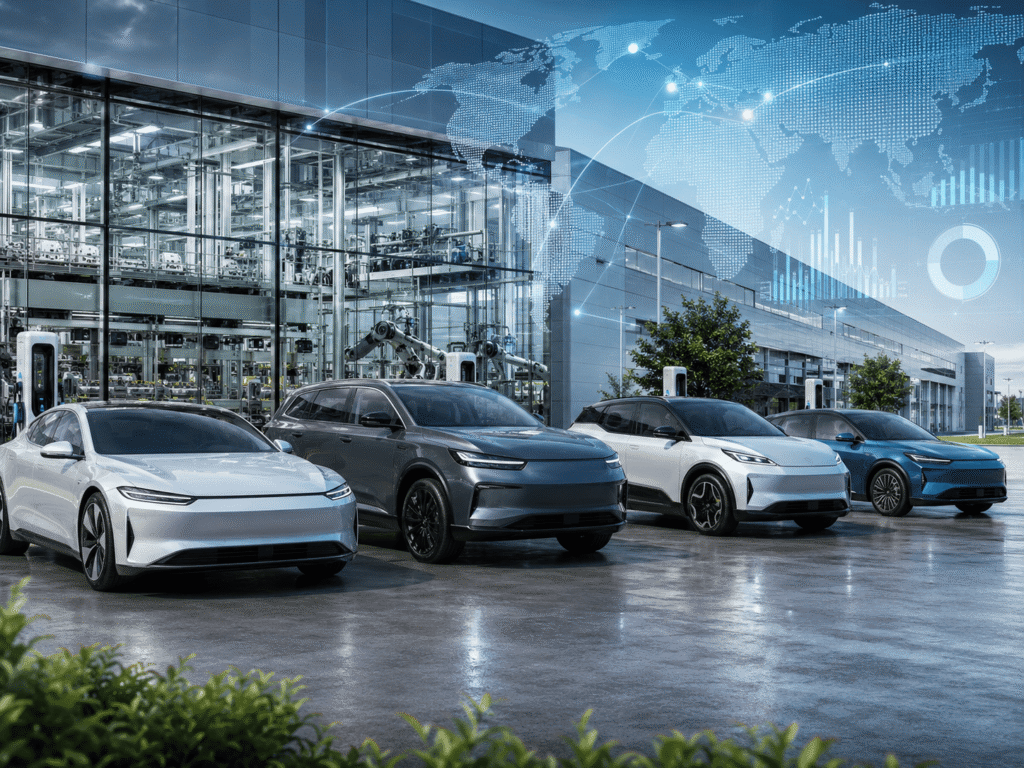
EV companies are growing fast because electric car sales are rising, battery prices are falling, charging networks are expanding, and buyers want cleaner, smarter vehicles.
Why EV Companies Are Growing Fast in 2026
Electric vehicle companies are growing fast because the car industry is changing at a speed we have not seen in decades. A few years ago, electric cars were still seen as a small niche. Many people thought EVs were expensive, limited, and mainly for early adopters. Today, that view is changing quickly.
EV companies are no longer only selling cars to technology fans. They are selling to families, commuters, businesses, fleet owners, luxury buyers, city drivers, and people who simply want lower running costs. More electric SUVs, sedans, hatchbacks, vans, and pickups are entering the market every year.
The growth is not happening because of one single reason. EV companies are growing fast because several things are happening at the same time: battery prices are falling, governments are supporting cleaner transport, charging networks are improving, buyers are becoming more comfortable with EVs, and companies like Tesla, BYD, Hyundai, Kia, Rivian, Lucid, Tata, Mahindra, Geely, NIO, XPeng and others are pushing the market forward.
In simple words, EV companies are growing because electric cars are becoming more practical, more affordable, and more normal.
1. Electric Car Sales Are Rising Worldwide
The biggest reason EV companies are growing fast is simple: more people are buying electric cars. Global EV sales have reached a level where electric vehicles are no longer a small experiment. Millions of buyers are now choosing EVs every year.
This matters because sales volume gives companies money to invest in better products. When EV companies sell more cars, they can build more factories, improve battery technology, expand charging partnerships, reduce production cost, and launch more models.
High sales also make suppliers more confident. Battery makers, chip companies, software teams, charging companies, tyre makers, and parts suppliers all invest more when they see EV demand growing.
This creates a cycle. More sales bring more investment. More investment brings better cars. Better cars attract more buyers. That is one of the main reasons EV companies are growing so quickly.
2. Battery Prices Are Falling
The battery is usually the most expensive part of an electric car. When battery prices fall, EV companies can make electric cars cheaper, more profitable, or more competitive.
Battery prices have already dropped a lot compared with the early days of EVs. BloombergNEF reported that lithium-ion battery pack prices fell again in 2025 to a record low. This is important because lower battery cost can help automakers launch more affordable EVs.
Cheaper batteries do not only help budget cars. They also help electric SUVs, trucks, vans, and luxury cars. A company can use the savings to improve range, add better features, or reduce the selling price.
This is one of the biggest reasons EV companies can grow faster now than before. A few years ago, battery cost made it difficult to build affordable electric cars. Today, that barrier is getting smaller.
3. Charging Networks Are Improving
EV companies grow faster when buyers feel less worried about charging. In the early days, many people liked electric cars but were afraid of running out of charge. Public charging was limited, slow, or unreliable in many places.
Now charging networks are expanding. More chargers are appearing at highways, malls, offices, hotels, parking areas, apartment buildings, and public stations. Fast chargers are also becoming more common.
This does not mean charging is perfect everywhere. Some regions still have weak infrastructure. But the direction is improving, and that gives buyers more confidence.
Charging apps also help. Apps like PlugShare, ABRP, ChargePoint, Tesla app and others make it easier to find chargers, plan road trips, check station status, and avoid broken chargers.
When charging becomes easier, more people consider buying EVs. That directly helps EV companies grow.
4. Governments Are Pushing Cleaner Transport
Government policy is another major reason EV companies are growing. Many countries want to reduce fuel imports, cut city pollution, lower carbon emissions, and support new technology industries. EVs fit into those goals.
Governments support EV growth in different ways. Some offer tax credits or purchase incentives. Some support charging infrastructure. Some create emissions rules that encourage automakers to sell cleaner vehicles. Some invest in local battery and EV production.
Policies are not the same in every country, and they can change over time. But overall, government support has played a major role in making EVs more attractive for companies and buyers.
For automakers, clear policy direction matters. If a country signals that cleaner vehicles are the future, companies are more likely to invest in EV models, factories, and battery supply chains.
5. Buyers Want Lower Running Costs
Many people are interested in EVs because they can be cheaper to run than petrol cars. Electricity often costs less than petrol for the same distance, especially if a driver can charge at home. EVs also have fewer moving parts, which can reduce some maintenance costs.
This is a big selling point for daily drivers. If someone drives to work every day, uses the car for family errands, or travels often in the city, fuel savings can become meaningful over time.
Petrol prices can also change quickly. When fuel prices rise, electric cars become more attractive. Buyers may not only think about the purchase price. They also think about monthly running cost.
EV companies benefit from this because lower running cost is easy to understand. A buyer may hesitate because an EV costs more upfront, but if the long-term running cost is lower, the decision becomes more appealing.
6. EVs Are Becoming More Practical
Early EVs often had limited range, small cabins, high prices, or unusual designs. Today, EVs are becoming more practical. Buyers can choose electric SUVs, sedans, compact cars, family vehicles, premium cars, pickups, and commercial vans.
This variety matters a lot. Not every buyer wants the same type of car. A family may want a three-row electric SUV. A city driver may want a compact EV. A business may want an electric van. A luxury buyer may want a premium electric sedan. A truck buyer may want an electric pickup.
As EV companies offer more body styles, they can reach more customers. This is one reason the market is growing faster than before. EVs are no longer only one kind of vehicle for one kind of buyer.
7. Chinese EV Companies Are Expanding Fast
Chinese EV companies are one of the biggest forces behind global EV growth. Brands like BYD, NIO, XPeng, Li Auto, Zeekr, Chery, Geely and MG are pushing hard in batteries, pricing, software, fast charging, and model variety.
China has a huge domestic EV market, strong battery suppliers, intense competition, and a powerful manufacturing base. This helps Chinese EV brands move quickly and launch new models at competitive prices.
BYD is especially important because it has grown into one of the world’s biggest new-energy vehicle companies. It sells battery-electric vehicles and plug-in hybrids, giving it a wide customer base. Reuters reported that BYD’s overseas shipments jumped strongly in May 2026, showing how important exports have become for its growth.
Chinese EV companies are also forcing traditional automakers to move faster. When one brand launches an affordable EV with strong features, others have to respond. That competition helps the whole industry grow.
8. Tesla Made EVs Desirable
Tesla played a major role in making electric cars popular. Before Tesla, many people thought EVs were slow, boring, or only for short city trips. Tesla changed that image by building cars that were fast, stylish, software-focused, and desirable.
The Model S, Model 3, Model Y, and Supercharger network helped Tesla become a global EV symbol. Even now, Tesla remains one of the most recognized electric car brands in the world.
Tesla also pushed the industry toward software updates, direct sales, charging integration, simple interiors, and strong EV performance. Other automakers had to pay attention.
Even when Tesla faces competition, its impact on EV growth remains huge. It proved that electric cars could be aspirational products, not just environmental products.
9. Software and Smart Features Add Value
EV companies are growing fast because modern cars are becoming more like smart devices. Buyers now care about screens, apps, navigation, driver assistance, over-the-air updates, voice assistants, route planning, charging information, and connected features.
Electric vehicles are well-suited to this shift. Many EVs are built around digital platforms. They can receive software updates, improve features, and connect with mobile apps.
This gives EV companies another way to stand out. They are not only selling a motor and battery. They are selling a connected technology experience.
For younger buyers, this matters a lot. A car that feels modern, connected, and easy to update may be more appealing than a traditional petrol car with older technology.
10. Fleet and Business Demand Is Growing
EV growth is not only about private buyers. Businesses are also interested in electric vehicles. Delivery companies, ride-hailing fleets, rental companies, taxi services, corporate fleets, and logistics companies are all looking at EVs.
For businesses, running cost matters a lot. If an electric van or car costs less to fuel and maintain over time, it can save money across a large fleet. Businesses also care about emissions targets and brand image.
As more companies electrify fleets, EV manufacturers gain more sales volume. Fleet buyers may buy hundreds or thousands of vehicles at once. That can help EV companies grow faster than relying only on individual customers.
11. More Investment Is Flowing Into EVs
EV companies are growing because money is flowing into the sector. Automakers, battery companies, software firms, mining companies, charging networks, and governments are all investing in the electric vehicle ecosystem.
New factories are being built. Battery plants are expanding. Charging networks are growing. Software teams are developing new platforms. This investment helps the industry scale.
Of course, not every EV startup will succeed. Some companies may struggle with production, cash flow, quality, or competition. But the overall direction of investment shows that EVs are now a major part of the automotive future.
12. Competition Is Making EVs Better
Competition is one of the biggest reasons EV companies are improving quickly. Tesla, BYD, Hyundai, Kia, Volkswagen, Toyota, GM, Ford, BMW, Mercedes-Benz, Tata, Mahindra and Chinese EV brands are all trying to win buyers.
This competition pushes companies to improve range, lower prices, add features, improve charging, and build better designs. Buyers benefit from this because more competition usually means better choices.
The EV market is not easy. Companies have to fight for attention. But that pressure creates faster improvement.
13. EV Companies Still Face Challenges
Even though EV companies are growing fast, the market is not perfect. There are still major challenges.
Charging infrastructure is uneven. Some areas have excellent charging, while others are still weak. EV prices are still high in some markets. Battery raw material prices can be volatile. Some buyers worry about battery life, resale value, insurance cost, and repair cost.
Competition is also intense. Price wars can hurt profits. Not every EV company will survive. Some startups may fail if they cannot scale production or control costs.
So EV company growth is real, but it is not guaranteed for every brand. The strongest companies will be those that can balance price, quality, battery supply, software, service, and customer trust.
Final Verdict
EV companies are growing fast because the world is moving toward cleaner, smarter, and more efficient transportation. Electric car sales are rising, battery prices are falling, charging networks are expanding, and more buyers are becoming comfortable with EV ownership.
Tesla helped make EVs desirable. BYD and Chinese brands are making EVs more affordable and scalable. Traditional automakers are investing heavily because they cannot ignore the shift. Battery companies and charging networks are growing alongside the car brands.
The result is a fast-moving industry where electric vehicles are becoming more practical every year.
For buyers, this means more choices, better technology, and stronger competition. For automakers, it means the future will not be won only by building engines. It will be won by building better batteries, smarter software, reliable charging partnerships, and vehicles that fit real people’s daily lives.
In simple words, EV companies are growing fast because electric cars are no longer just a future idea. They are becoming a normal part of the car market.
6) FAQ Section
Q1: Why are EV companies growing so fast?
EV companies are growing fast because electric car sales are rising, battery costs are falling, charging networks are expanding, and more buyers want lower running costs and cleaner vehicles.
Q2: Are electric car sales still growing in 2026?
Yes. IEA expects global electric car sales to reach 23 million in 2026, representing 28% of total car sales.
Q3: Why are batteries important for EV company growth?
Batteries are the most expensive part of an EV. As battery prices fall, EV companies can reduce prices, improve range, or increase profit margins. BloombergNEF reported average battery pack prices fell to $108/kWh in 2025.
Q4: Which EV companies are growing fast?
Tesla and BYD remain two major names, while Hyundai, Kia, Rivian, Lucid, Tata, Mahindra, Geely, NIO, XPeng, Li Auto and other brands are also expanding in different markets.
Q5: Will all EV companies succeed?
No. EV demand is growing, but competition is intense. Some companies may struggle with pricing, production, battery supply, charging partnerships, service support, or profitability.