Electric cars vs petrol cars: which is better in 2026? Compare running cost, charging, fuel, maintenance, range, performance, resale value, and daily ownership.
Electric Cars vs Petrol Cars: Which Is Better in 2026?
Buying a car in 2026 is not as simple as it used to be. A few years ago, most people only compared petrol cars by price, fuel average, engine size, comfort, and resale value. Now there is a bigger question in the middle of almost every car-buying discussion: should you buy an electric car or stay with a petrol car?
The answer depends on where you live, how much you drive, how easy charging is for you, and what kind of ownership experience you want. Electric cars are improving quickly. They are quieter, cheaper to run in many cases, smoother to drive, and better for people who can charge at home. Petrol cars are still familiar, easy to refuel, widely serviced, and often cheaper to buy at the start.
So, which is better in 2026? For many daily drivers, electric cars are becoming the smarter long-term choice. But petrol cars still make sense for people who travel long distances often, live where charging is weak, or want a lower upfront price. This guide explains the real difference in a simple way.
Why This Comparison Matters in 2026
Electric cars are no longer rare. More people are buying them every year, and more brands are launching new EVs. In 2025, global electric car sales crossed 20 million, which shows how quickly the market is changing. That does not mean petrol cars disappeared, but it does mean buyers now have a serious alternative.
The important thing is that electric cars and petrol cars solve different problems. An EV is usually better for city driving, daily commutes, home charging, low running cost, quiet driving, and modern technology. A petrol car is usually better if you need quick refueling, drive in areas with poor charging infrastructure, or want a cheaper used-car option.
This is why there is no single answer for every buyer. The best car depends on your lifestyle.
1. Purchase Price: Petrol Cars Often Start Cheaper
The first thing most buyers notice is price. In many markets, petrol cars are still cheaper to buy than electric cars. This is especially true in budget segments, where small petrol hatchbacks and sedans can be much cheaper than new EVs.
Electric cars cost more mainly because of the battery. The battery is the most expensive part of an EV, and even though battery prices have improved over time, they still affect the final price. Some EVs become more affordable after tax credits, government incentives, local subsidies, or lower registration fees, but those benefits depend heavily on your country.
Petrol cars have a clear advantage for buyers who only care about the lowest upfront price. If your budget is tight and you need a car immediately, a petrol car may still be easier to buy.
But price should not be judged only on day one. A car that is cheaper to buy can still cost more to run over several years.
2. Running Cost: Electric Cars Usually Win
Running cost is where electric cars often become more attractive. Electricity is usually cheaper than petrol for the same distance, especially if you can charge at home. This means your monthly driving cost can be much lower with an EV.
Petrol prices can change quickly, and fuel costs become a big issue for people who drive daily. If you commute to work, take school runs, or use your car for business, fuel bills can become painful. An EV can reduce that pressure if electricity rates are reasonable in your area.
AAA’s recent driving-cost analysis also noted that EVs generally have lower operating costs, especially fuel and maintenance. That is one reason many people who drive a lot start to find EVs more attractive over time.
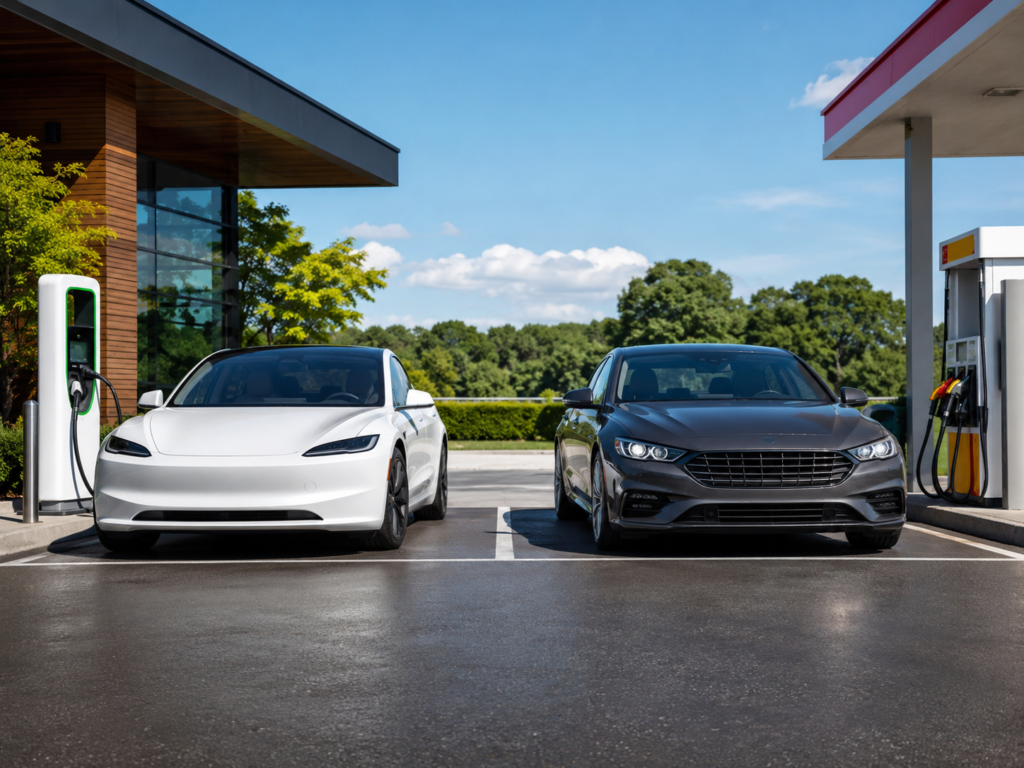
Petrol cars still have one advantage: refueling is fast and familiar. You can fill the tank in a few minutes almost anywhere. With an EV, charging takes longer, unless you have good fast-charging access or home charging.
3. Maintenance: EVs Are Simpler
Electric cars have fewer moving parts than petrol cars. They do not need oil changes, spark plugs, exhaust systems, fuel filters, timing belts, or many engine-related services. This can make EV maintenance simpler and cheaper over time.
Petrol cars need more regular maintenance because the engine has more mechanical parts. Oil changes, engine tuning, fuel system care, gearbox maintenance, exhaust repairs, and cooling system issues can all add up.
That said, EVs are not maintenance-free. They still need tyres, brakes, cabin filters, wipers, suspension checks, coolant checks, and software updates. EV tyres may also wear faster in some cases because electric cars can be heavier and have instant torque.
Still, for normal daily use, an EV usually has the maintenance advantage.
4. Range and Refueling: Petrol Cars Still Feel Easier for Long Trips
Range anxiety is one of the biggest reasons some buyers still avoid EVs. Modern electric cars have much better range than older models, but charging still takes more planning than filling a petrol tank.
If you mostly drive in the city, this is not a big problem. You can charge at home or at work and use the car every day without thinking too much. But if you often travel long distances, drive in rural areas, or live where fast chargers are rare, a petrol car may still feel easier.
Petrol cars have a huge refueling advantage because fuel stations are everywhere. You can stop, fill up, and continue quickly. EV charging is improving, but the experience depends on charger availability, charger speed, payment system, traffic, battery temperature, and whether the charger is working.
For long-distance drivers, petrol cars still have the convenience advantage in many places. For daily drivers with home charging, EVs can actually feel more convenient because you start each morning with a charged battery.
5. Driving Experience: EVs Feel Smoother
Electric cars usually feel smoother and quieter than petrol cars. There is no engine vibration, no gear shifting in most EVs, and power delivery is instant. Even a normal electric car can feel quick in city driving because torque arrives immediately.
Petrol cars can still be enjoyable, especially for people who like engine sound, manual gearboxes, and traditional driving feel. Some drivers enjoy the mechanical character of petrol cars. EVs are smooth and fast, but not everyone finds them emotional.
For daily driving, EVs usually feel more relaxing. They are quiet in traffic, easy to drive, and comfortable in stop-and-go conditions. For car enthusiasts, the choice depends on personal taste.
6. Environmental Impact: EVs Are Usually Cleaner Over Time
Electric cars produce no tailpipe emissions. That means they do not release exhaust smoke while driving. This is especially useful in cities where air pollution is a serious problem.
However, EVs are not completely impact-free. Battery production uses energy and raw materials, and charging an EV can still create emissions if the electricity comes from fossil fuels. But even with those factors, EPA notes that lifetime greenhouse gas emissions from EVs are typically lower than those from average gasoline vehicles.
The cleaner the electricity grid becomes, the better EVs become for the environment. If your country uses more renewable energy, EVs become even cleaner over time.
Petrol cars continue to burn fuel every time they drive. That means their emissions continue throughout the car’s life.
7. Charging at Home: The Biggest EV Advantage
If you can charge at home, an electric car becomes much easier to own. You do not need to visit a fuel station regularly. You simply plug in the car overnight and wake up with enough range for daily driving.
This is one of the biggest lifestyle advantages of EVs. For people with a garage, driveway, or dedicated parking space, charging at home can be cheaper and more convenient than petrol.
But if you live in an apartment, park on the street, or do not have reliable charging nearby, EV ownership can become harder. Public charging is improving, but it is not equally good everywhere.
Before buying an EV, ask yourself one simple question: where will I charge it most of the time? If the answer is easy, an EV makes more sense. If the answer is unclear, a petrol car may still be safer.
8. Resale Value: It Depends on the Market
Resale value is more complicated. Petrol cars have a long and familiar used-car market. Buyers understand them, mechanics know them, and resale pricing is more predictable in many regions.
EV resale value can vary. Some EVs hold value well, especially popular models with strong battery warranties and good charging support. Others may lose value faster if battery concerns, new technology, price cuts, or weak demand affect the market.
In 2026, EV resale is improving as more people understand electric cars. But in many markets, petrol cars still feel safer for resale because the buyer base is larger.
If you are buying an EV, choose a brand with good battery warranty, strong service support, and proven demand. That can help resale value later.
9. Insurance and Repairs
Electric cars can sometimes be more expensive to insure or repair. Batteries, sensors, cameras, and advanced electronics can increase repair costs after an accident. Some EV parts may also take longer to replace depending on the brand and location.
Petrol cars are usually easier to repair in many markets because parts and mechanics are widely available. This is especially true for older or common petrol models.
However, this gap is shrinking as more EVs enter the market. Over time, EV repair knowledge and parts availability should improve.
Before choosing between EV and petrol, check local insurance quotes. Sometimes the difference is small. Sometimes it can be a serious cost.
10. Best Choice for City Driving
For city driving, electric cars are usually better. They are quiet, smooth, efficient in traffic, and easy to drive. Regenerative braking helps recover energy, and low-speed city use is where EVs can be very efficient.
Petrol cars are less efficient in heavy traffic because engines waste fuel while idling and constantly accelerating. If your daily driving is mostly city-based, an EV can save money and feel more comfortable.
Best choice for city use: Electric car.
11. Best Choice for Long Highway Trips
For long highway trips, the answer depends on charging infrastructure. If your route has reliable fast chargers, an EV can work well. But if chargers are rare or unreliable, petrol is still easier.
Petrol cars are still better for people who often drive through remote areas, travel without planning, or need quick refueling at any time.
Best choice for long trips in weak charging areas: Petrol car.
Best choice for planned routes with good charging: Electric car.
12. Which One Is Better for Beginners?
For first-time car buyers, petrol cars are easier to understand because everything is familiar. Fuel stations, mechanics, servicing, and resale are simple.
For first-time EV buyers, the learning curve is mostly about charging. Once you understand charging, EV ownership becomes simple. In fact, many EV owners find it easier than petrol ownership because there are fewer service visits and no regular fuel stops.
If you can charge at home and your daily driving is predictable, an EV can be a great beginner car. If you cannot charge easily, petrol may be less stressful.
Final Verdict: Which Is Better in 2026?
Electric cars are better in 2026 for people who can charge easily, drive mostly in the city, want lower running costs, prefer quiet driving, and plan to keep the car long enough to benefit from lower operating costs.
Petrol cars are better for people who need a lower purchase price, travel long distances often, live where charging is weak, want quick refueling, or prefer a familiar ownership experience.
So the best answer is simple:
Choose an electric car if you have charging access and want lower long-term running costs.
Choose a petrol car if you need maximum convenience, lower upfront cost, and easy refueling everywhere.
For many modern buyers, especially city and daily commuters, EVs are becoming the smarter choice. But petrol cars are not useless in 2026. They still make sense for many people, especially in markets where charging infrastructure has not caught up yet.
The smartest buyer will not choose based on hype. The smartest buyer will choose based on real daily use.
6) FAQ Section
Q1: Are electric cars better than petrol cars in 2026?
For many daily drivers, yes. Electric cars are usually smoother, cheaper to run, and easier to maintain if charging is available.
Q2: Are petrol cars still worth buying in 2026?
Yes. Petrol cars still make sense for buyers who need lower upfront cost, quick refueling, easy repairs, and long-distance flexibility.
Q3: Which is cheaper to run: electric or petrol?
Electric cars are usually cheaper to run, especially when charged at home, because electricity often costs less than petrol for the same distance.
Q4: Which car is better for long trips?
Petrol cars are still easier for long trips in areas with weak charging infrastructure. EVs can be good for long trips if fast chargers are reliable on your route.
Q5: Which car is better for city driving?
Electric cars are usually better for city driving because they are quiet, smooth, efficient in traffic, and cheaper to run.