
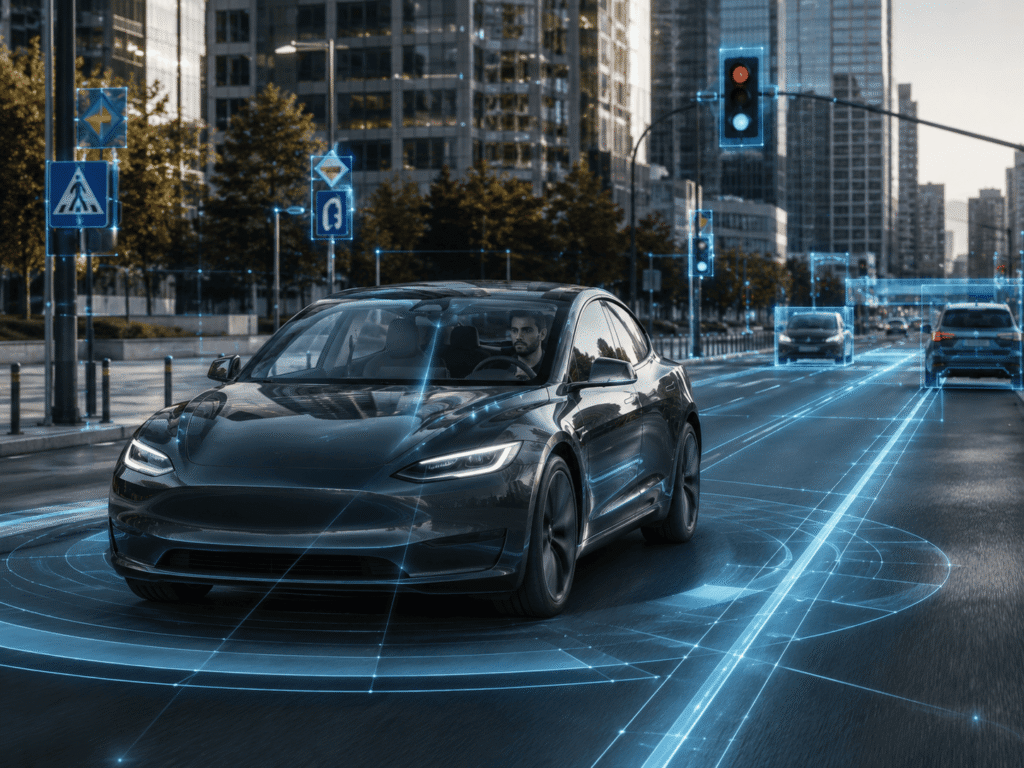
What is Tesla Full Self-Driving? Learn what FSD Supervised can do, how it works, what features it includes, why it still needs driver attention, and what beginners should know.
What Is Tesla Full Self-Driving? A Simple Guide for Beginners
Tesla Full Self-Driving, often called FSD, is one of the most talked-about features in the electric car world. Some people think it means the car can drive itself completely. Others think it is only a better version of cruise control. The truth is somewhere in the middle, and it is important to understand the difference.
Tesla now calls the system Full Self-Driving (Supervised). That word “Supervised” matters a lot. It means the car can perform many driving tasks, but the driver still has to pay attention and stay ready to take over at any time. It does not make the vehicle fully autonomous.
For beginners, the easiest way to understand Tesla FSD is this: it is an advanced driver-assistance system that can help with steering, lane changes, turns, traffic lights, intersections, highway driving, and route navigation, but it still needs a human driver watching the road.
This guide explains Tesla Full Self-Driving in a simple way, without technical confusion.
What Is Tesla Full Self-Driving?
Tesla Full Self-Driving is a software-based driving assistance system available on some Tesla vehicles. It is designed to help the car drive from one place to another under driver supervision.
When FSD Supervised is engaged, the car can attempt to follow the road, stay in lane, make turns, respond to traffic lights and stop signs, navigate intersections, enter and exit highways, and follow a route toward a destination. Tesla’s owner manual says FSD Supervised attempts to drive to your destination by following curves in the road, stopping at and negotiating intersections, making left and right turns, navigating roundabouts, and entering or exiting highways.
That sounds very advanced, and it is. But it is still not the same as a true driverless car. The driver is still responsible for the vehicle. You must stay alert, watch the road, keep your hands ready, and take control whenever needed.
Why Is It Called “Supervised”?
Tesla uses the word “Supervised” because the system still needs human monitoring. The car may handle many driving actions, but it can still make mistakes. It may misread a situation, choose a poor lane position, brake unexpectedly, hesitate, or fail to react correctly in unusual traffic conditions.
A supervised system means the human driver is still part of the safety process. You are not a passenger in a robotaxi. You are still the driver.
This is the most important thing for beginners to understand. Full Self-Driving does not mean you can sleep, watch videos, use your phone, or stop paying attention. Tesla itself says currently enabled Autopilot, Enhanced Autopilot, and Full Self-Driving features require active driver supervision and do not make the vehicle autonomous.
Tesla Autopilot vs Full Self-Driving
Many people confuse Tesla Autopilot with Full Self-Driving. They are related, but they are not the same.
Autopilot is Tesla’s basic driver assistance system. It usually includes features like traffic-aware cruise control and autosteer. That means the car can help maintain speed, follow traffic, and stay within a lane on supported roads.
Full Self-Driving is a more advanced package. It adds more complex driving behavior, especially on city streets and routes with turns, intersections, and traffic control. FSD is designed to handle more of the driving task, but still under supervision.
In simple words:
Autopilot helps mainly with lane keeping and speed control.
Full Self-Driving Supervised tries to handle more complete driving tasks, including navigation through city and highway routes.
Neither system makes the car fully autonomous.
What Can Tesla FSD Do?
Tesla FSD Supervised can do many impressive things when conditions are suitable. It can follow a route, steer through streets, respond to some traffic signs and lights, make lane changes, handle turns, navigate roundabouts, and enter or exit highways.
It can also display a driving visualization on the screen, showing lanes, vehicles, road markings, pedestrians, cyclists, traffic lights, and other objects. This helps the driver see what the system appears to understand.
Some FSD features may vary by country, vehicle hardware, software version, and local regulation. That means a Tesla in one country may not have the same FSD behavior as a Tesla in another country.
The important point is that FSD can assist with a lot of driving, but it is not perfect and not independent.
What Tesla FSD Cannot Do
Tesla FSD cannot legally or safely replace an attentive human driver in normal customer vehicles. It cannot guarantee that it will handle every road, weather condition, traffic situation, construction zone, emergency vehicle, pedestrian behavior, or unusual scenario correctly.
It also cannot remove your responsibility as the driver. If something goes wrong, you must be ready to intervene.
FSD may struggle in situations such as:
-
Confusing road markings
-
Construction zones
-
Poor weather
-
Unusual intersections
-
Aggressive traffic
-
Emergency vehicles
-
School zones
-
Pedestrians or cyclists behaving unpredictably
-
Poor visibility
-
Roads with unclear signs
-
Sudden obstacles
This is why Tesla tells drivers to remain attentive and ready to take over.
Is Tesla FSD Fully Autonomous?
No, Tesla Full Self-Driving Supervised is not fully autonomous in the way most people understand the word. A fully autonomous vehicle would be able to drive without human supervision in approved conditions. Tesla’s current customer system still requires active driver supervision.
This is why the name can be confusing. “Full Self-Driving” sounds like the car drives itself completely, but the official branding now includes “Supervised.” That supervised label is important because it makes clear that the driver still has a role.
A good way to explain it is this: Tesla FSD is advanced driver assistance, not a fully driverless robotaxi system for normal owners.
How Does Tesla FSD Work?
Tesla FSD uses cameras, onboard computers, software, and neural-network-based driving models to understand the road and make driving decisions. Tesla has chosen a camera-heavy approach, meaning it relies heavily on visual data from the vehicle’s cameras.
The car’s software tries to understand lanes, road edges, signs, traffic lights, vehicles, pedestrians, cyclists, and other objects. It then plans how to steer, accelerate, brake, and position the car.
Tesla also uses large amounts of driving data to improve the system through software development. Updates can change how the car behaves over time. This is one reason Tesla owners often talk about FSD versions and improvements.
However, real-world driving is extremely difficult. Roads are messy. People make unpredictable decisions. Weather changes. Construction zones appear. Signs can be blocked. Emergency situations happen. That is why supervision is still required.
Why Is Tesla FSD So Controversial?
Tesla FSD is controversial for several reasons.
First, the name “Full Self-Driving” can make some people think the car is fully autonomous, even though the system still requires supervision.
Second, Tesla has made ambitious claims about autonomy for many years, while real-world deployment has taken longer than expected.
Third, safety experts and regulators continue to watch the technology closely because any driver-assistance system can become dangerous if drivers overtrust it.
Fourth, some reports have raised concerns about FSD performance in difficult real-world scenarios. Reuters has reported that Tesla’s system still faces challenges in certain situations and that some people involved with training or reviewing the system have concerns about its readiness.
That does not mean FSD is useless. It means the technology is powerful but still developing, and drivers should treat it with caution.
Is Tesla FSD Safe?
Tesla says FSD Supervised can reduce collision likelihood when used under active supervision. Tesla has also published safety data around FSD miles driven. But safety claims around driver-assistance systems can be difficult to compare because roads, drivers, vehicle age, trip types, and reporting methods vary.
The safest approach for drivers is simple: use FSD as assistance, not as a replacement for attention.
If you use FSD, keep your eyes on the road, monitor what the car is doing, and be ready to take over instantly. The system may perform well most of the time and still make a mistake at the worst possible moment. That is the nature of supervised automation.
Who Should Use Tesla FSD?
Tesla FSD may be useful for drivers who understand its limits and are comfortable supervising advanced technology. It may help reduce stress in some driving situations, especially when the system works smoothly.
It may not be ideal for drivers who expect the car to do everything by itself. It is also not ideal for people who become distracted easily or trust automation too much.
A good FSD user is alert, calm, patient, and ready to intervene. They treat the system like a capable assistant, not like a chauffeur.
Is Tesla FSD Worth It?
Whether Tesla FSD is worth it depends on your driving style, local price, local availability, and how much you value advanced driver assistance.
It may be worth considering if:
-
You drive often
-
You like new technology
-
You understand supervision is required
-
FSD is available and supported in your region
-
You are comfortable monitoring the system
-
You plan to keep the car long enough to benefit from updates
It may not be worth it if:
-
You rarely drive
-
You expect full autonomy
-
FSD features are limited in your country
-
You do not like supervising automation
-
You prefer simple manual driving
-
The price feels too high for your use
For many buyers, the best approach is to test the system if possible before paying for it.
Tesla FSD and Robotaxis
Tesla often connects FSD development with its long-term robotaxi goals. A robotaxi is a vehicle that can carry passengers without a human driver. That is a much harder challenge than supervised driving.
FSD Supervised is not the same thing as a public driverless robotaxi service for normal owners. It is a supervised system in customer vehicles. Moving from supervised FSD to unsupervised robotaxis requires much higher reliability, regulatory approval, safety validation, and operational support.
This is why FSD is one of the most important parts of Tesla’s future, but also one of the most debated.
What Beginners Should Remember
If you are new to Tesla or EV technology, remember these simple points:
-
Tesla FSD means Full Self-Driving Supervised
-
It does not make the car fully autonomous
-
The driver must stay alert
-
It can handle many driving tasks
-
It can still make mistakes
-
Availability and features vary by region
-
Software updates can change behavior
-
It is advanced assistance, not a human replacement
Once you understand those points, the system becomes easier to judge fairly.
Final Verdict
Tesla Full Self-Driving is one of the most advanced and most debated driver-assistance systems available to consumers. It can do impressive things, especially compared with older cruise control or lane-keeping systems. It can help steer, navigate, respond to traffic controls, and manage complex routes under supervision.
But the key word is supervision. Tesla FSD is not a fully autonomous driverless system for normal owners. The driver is still responsible, still required to watch the road, and still expected to take over when needed.
In simple words, Tesla FSD is a powerful driving assistant. It is not a robot driver.
For tech-focused drivers who understand its limits, it can be exciting and useful. For people expecting a car that drives itself while they stop paying attention, it is not there yet.
6) FAQ Section
Q1: What is Tesla Full Self-Driving?
Tesla Full Self-Driving, now called Full Self-Driving (Supervised), is an advanced driver-assistance system that can help with steering, navigation, traffic lights, turns, intersections, roundabouts, and highway driving under active driver supervision.
Q2: Is Tesla FSD fully autonomous?
No. Tesla says currently enabled Autopilot, Enhanced Autopilot and Full Self-Driving features require active driver supervision and do not make the vehicle autonomous.
Q3: Can I use my phone while Tesla FSD is active?
No. You should stay attentive and ready to take over at any time. FSD Supervised is not a replacement for driver attention.
Q4: What is the difference between Autopilot and FSD?
Autopilot mainly helps with speed control and lane keeping. FSD Supervised attempts more complex route-based driving, including turns, intersections, roundabouts, and highway entry or exit, but it still needs supervision.
Q5: Is Tesla FSD safe?
Tesla publishes FSD safety claims, but independent reporting and safety experts continue to scrutinize real-world performance. The safest approach is to treat FSD as driver assistance, not a fully autonomous system.