Tesla vs BYD: which EV brand is leading in 2026? Compare sales, pricing, battery tech, charging, software, global reach, and future growth in this simple EV market guide.
Tesla vs BYD: Which EV Giant Is Leading the Market in 2026?
The electric car market used to have one obvious name at the top: Tesla. For years, Tesla was the brand people thought of first whenever electric vehicles were mentioned. It had the most attention, the strongest image, the best-known charging network, and some of the most recognizable EVs on the road.
But the market has changed. BYD is no longer just a Chinese car company growing quietly in the background. It has become one of the biggest forces in the global electric vehicle industry. Today, when people talk about the future of EVs, the conversation is no longer only about Tesla. It is about Tesla vs BYD.
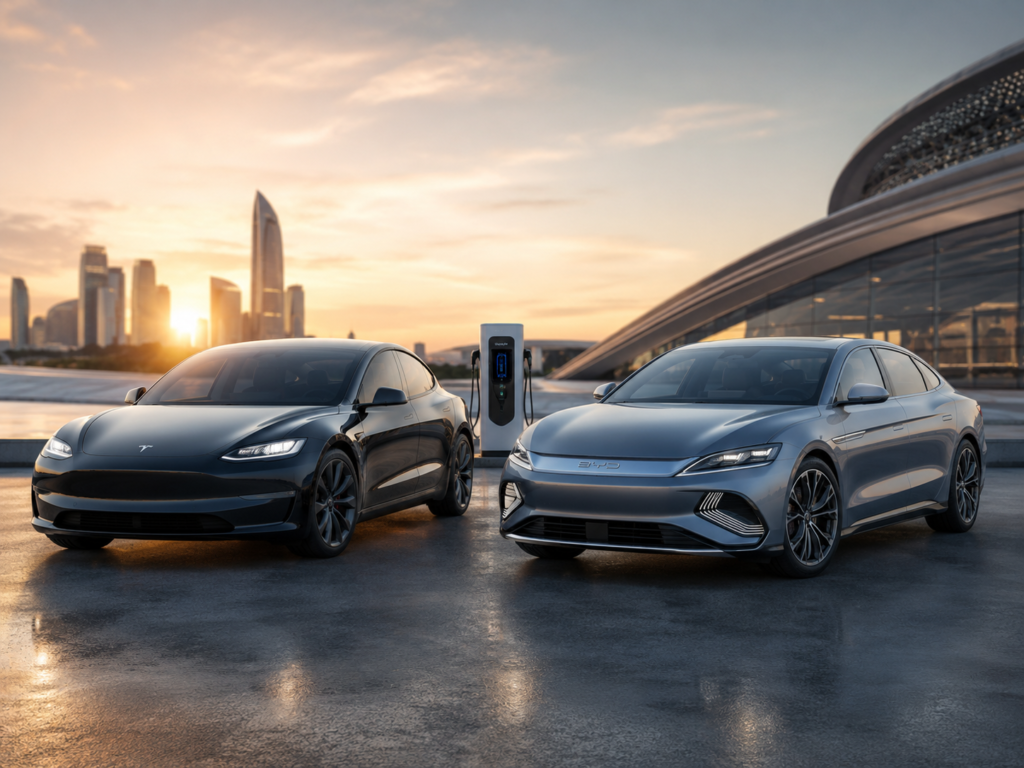
So, which EV brand is leading in 2026? The honest answer is not as simple as picking one winner. BYD is leading in volume, affordability, and product variety. Tesla is still leading in brand power, software image, charging experience, and global EV identity. Both companies are strong, but they are strong in different ways.
Why Tesla vs BYD Matters
Tesla and BYD are important because they represent two different paths in the electric car market.
Tesla became famous by making EVs exciting, premium, fast, and technology-focused. It turned electric cars from boring eco vehicles into desirable products. The Model S, Model 3, Model Y, and Supercharger network helped Tesla become a global EV icon.
BYD grew differently. It focused heavily on batteries, cost control, mass production, plug-in hybrids, affordable electric cars, and a wide product lineup. Instead of building only a few premium models, BYD created many vehicles for different types of buyers. That strategy helped it grow quickly, especially in China and other price-sensitive markets.
This comparison matters because the EV market is no longer about who has the coolest car. It is about who can build cars at scale, keep prices competitive, offer strong technology, expand globally, and still make customers trust the brand.
Sales: BYD Has the Volume Advantage
When it comes to sales volume, BYD has become extremely difficult to ignore. BYD sells both battery-electric vehicles and plug-in hybrid vehicles, which gives it a wider market reach than Tesla. Tesla sells only fully electric vehicles, while BYD can attract both full EV buyers and customers who are not ready to leave hybrid technology behind.
This is one of BYD’s biggest strengths. In many countries, buyers are interested in electric driving but still worry about charging access, range, and long-distance travel. Plug-in hybrids allow BYD to reach those customers. At the same time, BYD continues to grow its fully electric lineup.
Tesla remains a huge player, but its lineup is narrower. A large part of Tesla’s sales depends on the Model 3 and Model Y. These cars are still popular, but the EV market is becoming more crowded. Buyers now have many alternatives from Hyundai, Kia, BYD, Volkswagen, Mercedes, BMW, Toyota, and other brands.
In simple words: BYD is currently stronger in total vehicle volume, especially because of its wide mix of electric and plug-in hybrid models. Tesla is still one of the strongest pure EV names, but BYD’s scale has become a major advantage.
Brand Power: Tesla Still Has the Stronger Global Image
Even though BYD is growing fast, Tesla still has a stronger global brand image in many markets. For a lot of people, Tesla is still the first name that comes to mind when they think about electric cars.
Tesla has built a powerful identity around technology, performance, software, minimal design, and innovation. The brand is not only seen as a car company. Many people see Tesla as a technology company that happens to build cars.
That image helps Tesla in markets where buyers care about status, software, charging convenience, and brand recognition. A Tesla Model 3 or Model Y is instantly recognizable. Even people who do not follow cars know what Tesla is.
BYD is improving its global image, but in many regions it is still building trust. Some buyers know BYD as a battery and EV giant. Others are only just discovering the brand. This means Tesla still has an advantage in brand recognition, especially in North America and parts of Europe.
Pricing: BYD Is Often More Competitive
Pricing is where BYD becomes very dangerous for competitors. BYD has deep experience in batteries and manufacturing, and that helps it build cars at competitive prices. The company can offer small EVs, sedans, SUVs, plug-in hybrids, and premium models across different price ranges.
For buyers who want value, BYD often looks attractive. The brand can compete not only with Tesla, but also with traditional automakers. This matters because many people want to switch to electric cars, but price is still one of the biggest barriers.
Tesla has lowered prices several times in recent years, but it still does not cover as many affordable segments as BYD. Tesla’s lineup is simpler and more focused. That makes Tesla efficient, but it also limits choice.
BYD’s advantage is that it can sell cars to many different types of buyers. Someone looking for a budget EV may consider BYD. Someone looking for a plug-in hybrid SUV may also consider BYD. Someone looking for a more premium Chinese EV can also find options under BYD’s wider brand family.
Battery Technology: BYD Has a Major Strength
BYD started with battery expertise, and that background is a big part of its success. The company is known for its Blade Battery technology, which is designed around safety, durability, and cost efficiency.
Battery technology matters because the battery is the heart of an electric car. It affects range, charging, cost, safety, packaging, and long-term ownership. If a company can control battery production and reduce battery cost, it has a serious advantage.
Tesla also has strong battery technology and works with major battery suppliers, while also developing its own battery strategies. But BYD’s vertical integration gives it a different kind of strength. BYD makes batteries, vehicles, powertrains, and many key components in-house.
That does not mean Tesla is weak. Tesla remains very strong in efficiency, powertrain tuning, energy management, and software integration. But when it comes to battery manufacturing control and cost structure, BYD has a clear advantage.
Software and Driving Tech: Tesla Still Feels Ahead in Image
Tesla’s software experience is one of the biggest reasons people continue to choose the brand. Tesla vehicles feel digital-first. Updates, navigation, charging integration, app control, and the clean touchscreen interface all give Tesla a strong technology image.
Tesla’s driver-assistance systems are also widely discussed, even though they remain controversial in some areas. Whether people love or criticize Tesla’s approach, the company has kept itself at the center of the self-driving conversation.
BYD is not standing still. It is investing heavily in assisted-driving technology and smart vehicle systems. In China especially, the competition around driver-assistance features is becoming intense. BYD wants to show that it can compete not only on price and battery technology, but also on intelligent driving.
Still, from a global perception point of view, Tesla has the stronger software reputation. Many buyers choose Tesla because they believe the car will improve over time through updates. That expectation is one of Tesla’s biggest brand strengths.
Charging Network: Tesla Has a Strong Advantage
Charging is one area where Tesla has historically been very strong. The Tesla Supercharger network helped reduce range anxiety and made long-distance EV driving easier. For many buyers, this is one of the biggest reasons to choose Tesla.
In markets where the Supercharger network is well developed, Tesla ownership can feel simpler. The car knows where to charge, how long to charge, and how to plan a route. That convenience matters a lot, especially for first-time EV buyers.
BYD is working to improve charging access and fast-charging technology, but the experience depends heavily on the country. In China, BYD and other Chinese automakers are moving fast with charging infrastructure and advanced technology. In other markets, Tesla may still feel easier for long-distance travel.
So the winner depends on location. In many global markets, Tesla has the stronger charging experience. In China, the situation is more competitive because local EV infrastructure and Chinese brand technology are moving very quickly.
Product Lineup: BYD Offers More Choice
BYD’s product variety is one of its biggest advantages. The company offers small cars, sedans, SUVs, plug-in hybrids, full EVs, and premium models through different sub-brands and nameplates.
Tesla’s lineup is much smaller. The Model 3 and Model Y are the main volume sellers. The Model S, Model X, Cybertruck, and other projects have their own audiences, but Tesla depends heavily on fewer vehicles.
This creates a clear difference. Tesla focuses on a smaller number of models and tries to make them extremely recognizable. BYD focuses on covering many segments and price points.
For buyers, BYD may offer more flexibility. For brand strength, Tesla’s simpler lineup can also be powerful because its main models are easy to recognize and understand.
Global Expansion: BYD Is Moving Fast
BYD is expanding quickly outside China. Europe, Southeast Asia, Latin America, the Middle East, and other regions are becoming important for the company. Its overseas growth matters because it shows BYD is not only a China-focused brand anymore.
Tesla already has a global presence, with strong visibility in North America, Europe, China, and other regions. But BYD is gaining ground by offering competitive pricing and a broader range of vehicles.
The challenge for BYD is trust. In some markets, buyers still need time to understand the brand, service network, resale value, and long-term reliability. Tesla already has stronger recognition in many places, but BYD is closing the gap quickly.
Which Brand Is Better for Buyers?
If you want a car with strong software, a clean charging experience, strong brand recognition, and a tech-focused identity, Tesla may still be the better choice.
If you want more affordable options, more body styles, plug-in hybrid choices, and strong value for money, BYD may be the smarter option.
For a first-time EV buyer, the decision should not be based only on the brand name. It should be based on local price, warranty, charging access, service support, real-world range, and how the car fits your daily routine.
Who Is Leading in 2026?
BYD is leading in total scale, product variety, affordability, and battery-focused manufacturing strength. It is becoming the company that proves EVs can be produced and sold in huge numbers across many price levels.
Tesla is still leading in global EV image, software reputation, charging convenience in many regions, and the emotional pull of being the original modern EV leader.
So the final answer is this: BYD is currently leading in volume, while Tesla is still leading in brand power and software identity. The EV race is not finished. In fact, it is becoming more interesting.
Final Verdict
Tesla vs BYD is not just a brand comparison. It is a picture of where the electric car industry is going.
Tesla made electric cars desirable. BYD is making electric cars more widely available. Tesla pushed the world to take EVs seriously. BYD is showing how quickly EVs can scale when pricing, battery production, and product variety come together.
For buyers, this competition is good news. It means better cars, lower prices, faster technology, and more choices. Tesla may still feel like the stronger technology brand, but BYD is becoming the stronger volume player.
In 2026, the EV leader depends on what you measure. If you measure sales scale and affordability, BYD has the edge. If you measure brand image, software experience, and charging convenience, Tesla still has a strong position.
The real winner may be the customer, because Tesla and BYD are pushing each other to build better electric cars.
6) FAQ Section
Q1: Is BYD bigger than Tesla in EV sales?
In recent global sales volume, BYD has become larger when counting its full new-energy vehicle business, and it has also overtaken Tesla in reported 2025 battery-electric sales.
Q2: Is Tesla still better than BYD?
Tesla is still stronger in brand image, software reputation, and charging convenience in many regions. BYD is stronger in affordability, model variety, and total vehicle scale.
Q3: Which brand is better for first-time EV buyers?
Tesla may be better for buyers who want simple charging and strong software. BYD may be better for buyers who want more affordable choices and different body styles.
Q4: Why is BYD growing so fast?
BYD benefits from battery expertise, competitive pricing, a wide lineup, plug-in hybrid options, and rapid global expansion.
Q5: Who is leading the EV market in 2026?
BYD is leading in volume and affordability, while Tesla still leads in brand power, software identity, and EV image.